Explore. Play. Create. Be adventurous. Discover. Have fun.
Marbling with shaving cream is delightful! My artistic and creative friend Quinn McDonald had never tried this so we did some yesterday on paper. I love sharing techniques with others. Especially when they are as adventurous and willing to explore as Quinn.
Here are photos of some of the steps we took:
Shaving cream on plastic. Hair pick to the left
Dropping inks onto shaving cream.
Inks moved with hair pick.
Hair pick used to move inks.
Pull #1
I forgot to take photos of laying the paper on top of the shaving cream once your colors are moved the way you like them. Just make sure your paper makes full contact with the colors on the cream before lifting it and scraping off the excess shaving cream.
Pull #2
Pull #3
Pull #1
Another first pull.
Pull #2 or #3
Marbling with shaving cream is a fun and easy activity that can be done by adults, children, seniors, or for class room activities.
You can do it almost anywhere.
All you need is
a flat surface
a cover to protect your flat surface (i.e. foil, foil pan, a cut open garbage bag, wax paper)
shaving cream (not gel)
ink or paints - Permanent inks like Dr. Ph. Matin's, acrylic inks, Adirondack inks by Ranger, acrylic paints, fabric paints almost anything will work, just try it.
a tool for moving paint across the surface (i.e. hair pick, wide tooth comb, wooden skewers)
Paper - you can experiment with copy/printer paper, watercolor paper, drawing paper, etc.
a scraper or squeegee for scraping the extra shaving cream off of your papers to reveal the design.
Playing with friends - what does that bring to mind for you? For me, it was a lovely January afternoon in Phoenix creating monsoon papers with artists Quinn McDonald and Traci Paxton. We played in an unattached way - which I define as 'seeing what happens when . . .' and being completely unattached to the outcome. The joy is in the playing and the discovery that the playing leads to. Our explorations with inks, a water hose and Arches Text Wove paper yielded these wonderful pieces of paper. Fun, fun, fun.
I have thought about joining Creative Every Day for almost two years. It is a challenge set up by Leah Piken Kolidas to encourage others to create. You don't have to create every single day - you do what works for you, so there is no need to spend time whipping yourself if you happen to go a day without sharing some creative aspect of your life.
Leah defines creative in the broadest sense of the word and you can read about the challenge on her Creative Every Day challenge page.
While I was working at the studio today, I decided I wanted to do some painting. I don't often paint on canvas but I took a recycled canvas that happened to have torn pieces of paper collaged onto it. I decided to let it emerge as I painted and this is my result of my efforts. I love the texture and colors of the collaged paper. It was fun to create a piece that I like from a piece that another artist tossed away for reasons of their own.
Exercises like this are a great way for me to get out of my head and just go with it. I have been taking pictures of trees lately on my almost daily walks in the park and I am quite happy with the way this tree turned out. I did the writing with a white gel pen. The photo at the top is more true to the colors but the bottom one is a bit clearer.
I spent a very calm new year's eve working (at an art studio) and carving the first side of my 6 inch by 4 inch piece of soft-cut block that I believe is made by Speedball (no affiliation). This first photo is the full stamp and the second is a closeup that shows you all of my imperfect cuts.
I think that 2012 will be a year that I leave room that allows room for imperfections, since my focus will mostly be experimenting and exploring as I create. As processes emerge from my experiments, I will learn a lot. You can see from the stamp being covered with paint and how the stamp looks on fabric, there could be some improvements if I choose to make an absolutely perfect carved stamp. But I kind of like the less formal addition of personality that the imperfect cuts add to the piece. I also love the idea of 'allowing' the imperfections to be part of the work. Just like imperfections are part of us and part of life.
It was pretty easy not to fret over the lines that are not straight. I learned a bit about which tool might give me the look that I want and which tool scoops the way I need.
One of the best parts of using this soft-cut block is that it is thick enough to cut another design on the flip side.So once finished, I flipped it over and started a new stamp. I like it too.
Flowing lines and bubbles inspired by the Raw Art Journaling technique of Free-Floating Bubbles (p.77). Disclosure, yes, author Quinn McDonald is a good friend of mine and I love this book of hers. The openness of my lines and bubbles design allows for the addition of words after stamping. I will probably use markers or gel pens to add words to the fabric.
~ o ~ o ~ o ~ o ~ o ~ o ~ o ~ o ~
And I can't sign off without wishing you and yours a very Happy New Year! May the year 2012 be one in which you realize your dreams and take some of those risks you have previously been hesitant to take.
Sometimes I forget to take a few moments to be thankful. Thankful for the beauty that surrounds us. Thankful for the ability I have to know when to jump in and when to step away; this serves me well.
Thankful for my friends and family because they bring joy and a special kind of light to my life.
Thankful that even in the face of uncertainty, it is possible for me to stay out of the panic-zone and remain in the creative zone where thinking happens and possibilities can be explored.
Since being laid off, I am thankful even for that, because it has given me the freedom to think about and choose where I want to spend my time. Freedom to look at making money doing the things that make me happy and make a difference, in some small way, to others. I am grateful to be such a blessed individual.
What are you grateful for? Please leave them in the comments. It is hard to be sad, mad and down when you let yourself consider the things you are thankful for. Try it.
(this link will take you to the Interweave Store video download page for the video)
If you like to try different techniques for fabric. If you love learning visually. If you love having someone explain things in clear and easy to understand ways. Then you’ll probably like this video. It is available from Interweave both as a download and as a DVD.
When you visit the Interweave page about this video there is a supply list broken down for you into categories. To me, supply lists are intriguing because even though you think you know what the instructor will do with particular items, often there is the surprise of how they have chosen to use those supplies.
The video is divided into four segments and each of those segments was packed with information that was useful to me. Some of the information was a great reminder of things I had seen or heard before and some was totally new.
First Segment – Eraser Stamps. I have thought about making stamps from erasers many times and just haven’t gotten around to it. Lyric’s very clear instructions on how she cuts the stamps and her tips on cutting were great. I love the examples and demonstrations of how she uses the stamps and groups of stamps in creating her artwork.
Second Segment – Screen Printing & Stenciling. This is a great refresher or introduction on using screen printing techniques on fabric. Lyric talks about traditional screen printing and touches on thermofax screens as well. Lyric also covers a variety of stencil materials that you can do yourself with materials you probably already have at home. She also touches briefly on mixing colors in this segment and shares with the viewer the types of paints she uses to add color to her work.
Third Segment – Foiling and Photo Copy Transfers. I love foiling and Lyric covers this well and demos how to use a variety of adhesives, including her favorite for this technique. I found it hard to understand the name of the supplier for her favorite adhesive but you can find it on her website, in the links section, under Surface Design Supplies.
I must go and get some Citra-Solv. I have never used this product but Lyric’s demonstration of a photo copy transfer technique using this made me want to run out to the store and get some. It looks really easy and I can’t wait to try it.
Fourth Segment – Lyric show you have to make a little quilted journal slip cover. Her technique for finishing makes it really easy.
Overall, I thought this was a great video. I learned some techniques I did not know and was re-inspired about techniques I did. Lyric has a voice and way of talking that is easy to listen to and her explanations are uncomplicated. Whether you are a beginner just starting out in your explorations with techniques for surface design or you are experienced and looking for a bit of inspiration, this ‘sampler platter’ can be a great addition to your library.
I would love to hear your comments if you've watched this video or have thought about getting it.
I love using masks in my creative work, usualy along with stamps and stencils. My thanks to the very talented artist Dina Wakely, who happens to live here in Arizona. She is a wonderful teacher and also runs a mixed media group that meets once a month at The Creative Quest in Glendale, Az.
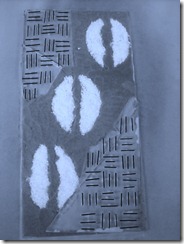
I have used a mask on this postcard by cutting shapes out of a clothing catalog. I cut out three shapes of women in different poses, layed them together and used a paintbrush to pull paint around the edges of the shape. That gave me the shape surrounded in purple on this fabric postcard.
I could have painted or stamped on the fabric first, but after painting, I used a marker to put the quote from Maya Angelou in the center. I used a ginko leaf rubber stamp with Lumiere paint and used a piece of punchinella as a stencil to add more color to this postcard. And finally, with a hair comb dipped in paint, I made those red lines that you see.
I keep catalogs and magazines and occasionally while watching television or movies will flip through them to find shapes that interest me. I cut them out and might spend a different session painting them with a coat of gel medium so I can use them more than once. If you coat your pieces with gel medium, do it on a piece of plastic so you will be able to lift the piece when dry and turn it over to paint the other side.
Sometimes I'll remember to save both the actual mask and the stencil that is created when cutting out the shape - like this woman from an old catalog I had lying around.
That little strip of blue that you see on the stencil is painters tape that I used to reinforce the portion where I cut very close to the edge. I wanted to give it some stability.
I glued the mask to a file folder, coated it with gel medium, cut it out, laid it on a piece of plastic, coated the back with gel medium as well. I also coated the stencil on both sides.
Thank you for visiting my blog. I would love to hear about your adventures with this technique.
I signed up this week to join a swap on the Surface Design Yahoo Group. The theme of this swap is landscape texture postcards so we have to do fabric postcards with texture and depth to them. We only have to make 4 so I think I can get these designed and out in the mail in time for the deadline of June 20th. Some of my postcards will be going to people in Australia. I love how connected the world is today.
Now what should I do for my postcards? What immediately came to mind was to maybe use some of my photos for inspiration.
Maybe one of these that I took from the car on a trip to Sedona last year:
Hmmm. All of these qualify as landscapes. All three have great visual texture with a lot of options for recreating those textures on fabric. None of these are stellar photographs but they do not have to be since I will add and/or subtract things to make the piece work as a postcard.
And who knows, maybe working on these postcards will spark some ideas for a larger quilted landscape.
As always, click on any photo for a larger view and comments are always welcomed.
Look at all of the pretty cacti. I know this sounds a little bit funny. It is hard to think of a cactus as something pretty when we all know about those prickly, stick-y, ouch-y, hurt-you-if-you-touch-them spines that many cacti have.
Those spines are part of the reason that cacti survive in dry climates like the desert because the spines help reduce the evaporation or loss of water by the plant. The spines also offer wonderful protection.
Cacti are flowering plants and I never think much about the fact that they bloom. So I was absolutely delighted to see the blooms on a recent visit to the Desert Botanical Garden in Phoenix, AZ.
The slideshow below shows an assortment of cacti and some of their blooms.
In honor of National Poetry month. I came up with this little cinquain after my walk the other day. A cinquain is a 5-line poem and I used the word-structure of 1,2,3,4,1 . I think this would make a fun little quilt, hmmmmm.
Kay Sorenson is one of the many art quilters on the Quilt Art list who recently shared her need for a ‘mindless’ sewing project that we all sometimes need. The kind where not a lot of thinking is involved, just the joy of sewing that also yeilds a result.
I had never seen this technique before but it looks easy and fun and Kay’s quilt has the most beautiful batik fabrics in glorious colors.
I have seen this referred to as ‘Lasagne’ style quilt. Apparently, as you can see in this video
from the Heirloom Creations blog they held a race using a jelly-roll to make a quilt. They provide the instructions on their blog and have photos of some of the quilts made during the 'race'.
FYI – a jelly-roll is a collection of about 40 fabric strips that are pre-cut to 2.5” by 44”. They come in assorted colors. A search of the term jelly roll fabrics will give you a lot to look at.
Here’s a blog post from CakesbyKristin blog about this style of creating a quilt that has great ‘up-close’ photos.
A lot of ideas came to mind while looking at this quilt:
• Baby quilts (you probably would just need to shorten the original strips; you could put cool little motifs in between each strip or group them in colors pink, blues, pastels, brights)
• African fabrics (w/ maybe a unifying little block of color, like red, in between each strip)
• Great quilt for free motion practice because no one would be able to see any of the mistakes made.
• Great for playing with colorways, can’t you just see one in greys and blacks or purples or blues or black & white fabrics or reds, or red & white fabrics . . .
• Great way to create a bunch of quilts to donate – you don’t have to spend a lot of time thinking about color and placement, just enjoy the sewing
• Probably the most time consuming part, aside from cutting your own strips, would be stitching them end to end. I know that I am the type who would not sew them on the diagonal but just straight end-to-end, like I do my binding strips
• Leftover Christmas or other holiday fabrics
• Leftover hand-dyed fabrics, or not leftover
• Shiboried fabrics
• Fabrics you’ve created using various surface design techniques and don’t know what to do with
Having some fun with this little fabric postcard. Trying out quilting lines and little circles. I really like the little circles and keep getting better at them as I go. I notice that once I've gone over it with paint, the eye tends to see the whole and not the individually messy lines I made as I did this. Which is great since I wasn't concerned with being perfect, just enjoying the zen of machine stitching and free-motion quilting.
The fabric is handpainted. I taped off sections of it so I could write the words. The word engage is done with a calligraphy marker. The other words were done with a micron fine tip.
I used various colors of rayon thread and then went over the parts left in relief with Shiva paintstiks. The gold is obvious but there is also iridiscent red and iridescent purple. It is hard to know when to quit. I just need to go over the letters with a gel pen I think, to make the other words pop out more. They are sort of lost in everything else.
Stuff like this makes doing loads of laundry and dishes go much faster.
I have four or five of these that I was going to use in a swap and changed my mind. So I did some quilting on another one and think I'll put some beads on this one.
If you have a moment, let me know what you think of these. And click on the photos if you want a closer look.
Thanks for stopping by and I hope your Saturday is satisfying.